
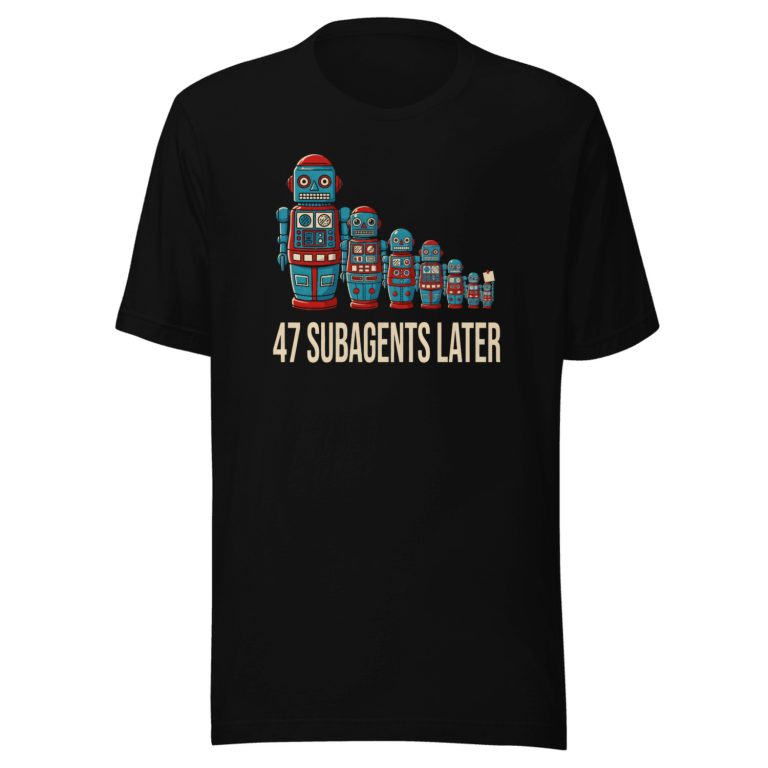
Forty-seven is not a technical limit. It is the number at which a developer watching the screen stops counting and goes to put the kettle on.
To see why it gets that high, start with agents. An AI agent is a model that works in steps towards a goal instead of answering once. It reads files, runs commands, searches, checks the result and decides what to do next, looping until it thinks the job is done. Coding tools increasingly work this way.
What a subagent is
A subagent is a separate agent that the main one starts for one piece of the work. The main agent writes it a brief (“find every place this function is used”, “check whether the tests pass”), and the subagent goes off with its own instructions and its own empty context window, the short-term working space every model has. When it is finished, it sends back a summary, and the main agent carries on.
There are good reasons to work like this. The main agent’s working space stays uncluttered, because the subagent read the forty files and only the conclusion comes back. Several subagents can run at the same time. Each can be set up for a narrow job, with only the tools it needs. In some setups a subagent can start helpers of its own, and that is how one small request turns into a long procession.
What it costs
Each subagent starts from nothing, so it often rereads material the main agent already had, which takes time and money. The bigger cost is that a summary is a summary. Details get dropped on the way up, and a subagent’s mistaken conclusion arrives at the top looking exactly like a fact. If a helper reports that it ran the tests and they passed, the main agent has no particular reason to doubt it.
Then something breaks, and the final report explains, in calm and reasonable language, which subagent was responsible.
Why developers laugh
Because it is an org chart. A manager delegates to a team lead, who delegates to a junior, who does the work quickly and reports that it went well. The manager passes the good news upwards. Nobody above the junior has looked at the code. When it goes wrong, everyone can point one level down.
People building agent systems spend real effort on exactly this: how much to delegate, how to check what comes back, how to stop a chain of confident summaries from drifting away from what actually happened. The joke is that the machines have reinvented middle management in about a year.
The merchandise
47 Subagents Later shows seven tin robots in red and teal, big to tiny, like nesting dolls. €26 as a tee, and there is a hoodie. The pointing is on the Blame the Subagent mug, €16: an orange robot points at a much smaller teal one, who waves back as if this might still be fine.
See the Agents at work collection for the rest, the Secret Santa guide if you need something under €20, or rate limits, which is what forty-seven helpers tend to run into.