HTTP status code 429 has a name of admirable bluntness: Too Many Requests. It is what a web service sends back when you have asked it for things faster than it is willing to answer. It is the most polite refusal in computing, and engineers see it daily.
What a rate limit is
A rate limit is a cap on how much one user, app or account can ask of a service in a given period. The classic form is requests per minute: you may call this address 60 times a minute, and the 61st call gets turned away. AI services usually add more limits on top, counting the amount of text processed per minute and per day, because one enormous request costs them far more than one small one.
Services do this for plain reasons. Their servers have finite capacity. They want one heavy user not to slow things down for everyone else. They want to stop abuse, like someone trying a million passwords. And every request costs them money, so limits are also how the cheap plan differs from the expensive one.
What happens when you hit one
The service answers with that 429 error instead of a result. Often it adds a header called Retry-After, which says how many seconds to wait before trying again. People using a chat app see the friendly version: you have reached your limit, try again at 3 p.m.
What a program does next separates good software from bad. The bad version retries immediately, in a tight loop, which makes the overload worse and can get the account blocked. The good version waits, then tries again, and if it is refused again, waits twice as long: one second, two, four, eight. This is called exponential backoff. Good clients also add a little randomness to each wait, called jitter, so that thousands of programs refused at the same moment do not all come back at the same moment too.
Anyone who has built software on top of an AI service has written this waiting logic, watched it work, and then watched a deadline go by while it politely waited.
The appeal
Rate limits are the one situation in computing where saying no is not just allowed but correct, and it comes with a technical justification and a time to come back. Humans want that badly. “I would love to help, but I am rate limited” is a better excuse than anything the rest of us have.
The cat understood this long ago. It has received too many requests, from you, about the sofa. It will consider them after a nap.
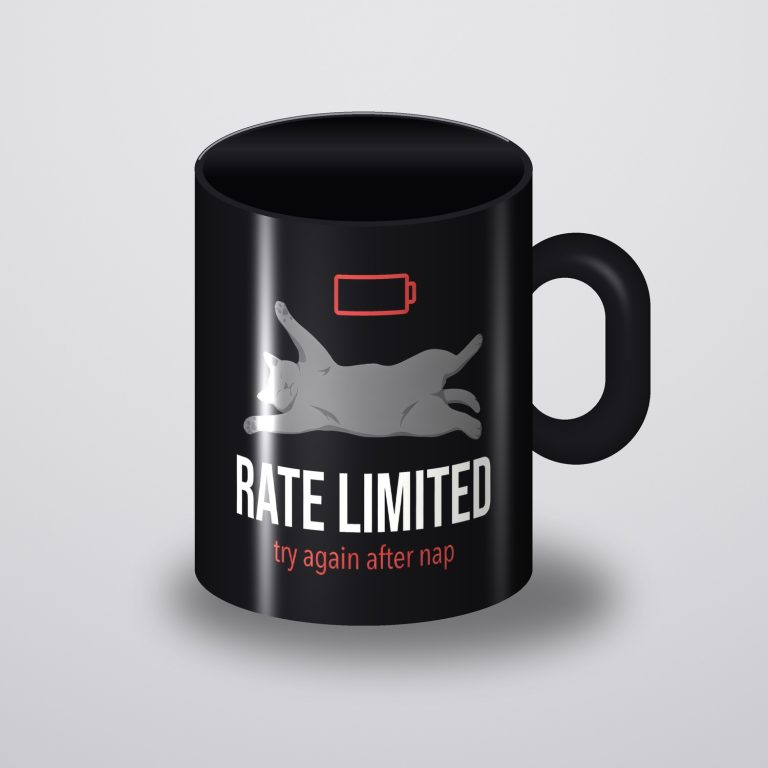
Rate Limited Cat is a €16 mug: a grey cat flat on its back under an empty red battery, with a small note saying try again after nap. The human version is the I Would Help but I Am Rate Limited tee, €26, where a tortoise lies stuck on its back in the desert while a small robot beside it carries on reading.
If you are buying for someone who handles everyone else’s emergencies, try the guide to gifts for sysadmins and on-call engineers. The Secret Santa list has the mug too, and the Cats and AI humour collection has more cats with opinions.