A big training run can take days. For most of that time, the person who started it watches a line on a chart creep downwards and tries not to touch anything. That leaves plenty of time to develop jokes, and the jokes are specific.
That specificity is the problem for anyone buying them a present. The shirt has to use a term they use, correctly, or it reads as a gift from someone who searched “AI shirt”. Each pick below comes with a line on what the term means, so you can match it to their work. They are ordered roughly the way a model gets made: training, testing, then what happens inside it and what happens when people use it.
First, the calendar. Everything is printed after you order it, usually in 2 to 5 business days for clothing and mugs, then shipped, usually 3 to 8 business days inside the EU. For Christmas, our production partner’s 2026 holiday table gives 6 December as the last standard order day for clothing and homeware going to Germany, subject to change; we have not confirmed dates for other countries. Tees and hoodies are unisex, S to 2XL, and the shipping and returns page has the rest.
Training
Gradient Descent Ski Cat tee, €26. Gradient descent is how most models learn: work out which direction makes the error smaller, take a step that way, repeat. A local minimum is a dip where every direction looks uphill, so the process can stop there. The shirt is a vintage ski poster with a cat sliding down on its back towards a plaque reading LOCAL MINIMUM. To someone who trains models, that plaque is the punchline. (Gradient descent in plain words.)
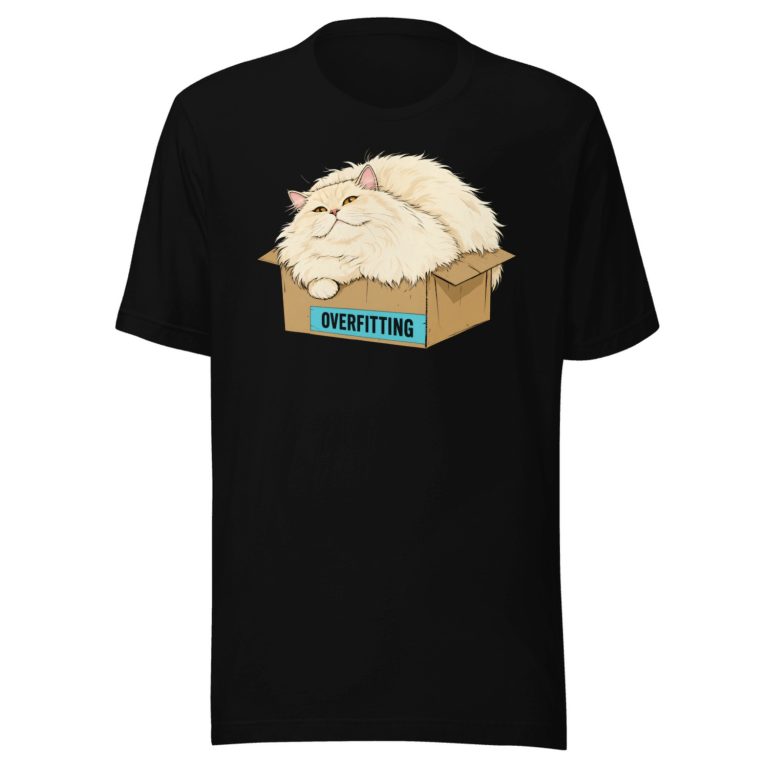
Overfitting Box Cat tee, €26. Overfitting is when a model learns its training data so precisely, quirks and all, that it fails on anything new. A very fluffy cat in a box several sizes too small makes the point. It suits the colleague who keeps warning everyone about it.
Fine-Tuned on Treats Cat mug, €16. Fine-tuning means taking a trained model and training it a little more on one narrow subject. This cat specialised in treats until the jar was empty. A safe mug for people who adapt existing models rather than build them. 11 oz, printed on both sides.
Reward Hacking Treat Machine tee, €26. Reward hacking is when a system finds a way to collect the score without doing the task the score was meant to measure. A tuxedo cat in a bow tie has found the big red button on the treat machine. People in reinforcement learning tell reward-hacking stories the way sailors tell storm stories. (More on reward hacking.)
Self-Supervised sticker, €4 to €5. In self-supervised learning a model makes its own practice questions from raw data, for example by hiding a word and guessing it back. The sticker takes the name literally: a grumpy robot holding up a clipboard to a mirror, and the reflection holding one back. Laptop size, 3 or 4 inches.
Testing
The Model Is Fine, the Evals Are Wrong hoodie, €49 to €53. Evals are the tests used to score a model. When the scores come back bad, blaming the test is tempting, and now and then it is even correct, which is what makes the line funny. It is also on a tee, a robot badge tee and a mug.
Inside the model
Latent Space Program Patch tee, €26. Latent space is the internal map where a model places what it has learned, similar things close together. Nobody can look at it directly, so this mission patch sends a cat in a cardboard box rocket instead. It suits the researcher who makes charts of embeddings and calls them beautiful.
Let Me Think About This Step by Step tee, €26. Asking a language model to reason step by step tends to improve its answers. The small robot on this shirt is walking briskly up a staircase that stops in mid-air. People who write prompts for a living will know the feeling.
Using the model
Private Inference Cat Detective tee, €26. Inference is running a trained model to get answers; private inference means doing it on your own hardware so the data stays put. Here the phrase is lettered on a detective’s office door, with a cat in a trench coat walking past in the rain. For the privacy-minded engineer who also likes a bit of film noir lighting.
Ran Out of Tokens Mid tee, €26. Models write within a fixed budget of tokens, roughly word fragments, and when the budget runs out the answer simply stops. The shirt does exactly that, with a green cursor waiting for the rest. Anyone who has watched a long answer die three lines from the end will laugh.
Not from us
A good statistics book written for general readers. The kind that explains why most charts in the news are misleading. Experts enjoy seeing their field explained well.
A donation to an open-source library they use. Much of their daily stack, from the number-crunching libraries to the plotting tools, is maintained by small teams that accept one-off donations. A few tees are a thin cotton that can look see-through in bright light, and the product page says so where it applies. The whole range is split between Cats and AI humour and Agents at work.